Brand guidelines governance is the system that sets who owns the brand rules, who can approve exceptions and changes, and how finished work gets checked.
A rulebook cannot tell you whether the logo may sit on a busy photo, and it will not notice that a sales deck still carries last year's claims. Someone has to own those calls, and the team has to be able to see whether the rules hold up in real work.
I read the five public pages that rank for this query (Frontify, Marq, Inch Creative, Lingo and Interbrand) and compared them on November 19, 2026, along with our own two related articles. The four guides among them (Frontify, Marq, Inch Creative and Lingo) explain guidelines versus governance and recommend approvals, training and audits; Interbrand's page is a short service page. None gives a decision-rights table per guideline part, an exception process with an expiry date, or a sampling method with a pass rule. Those three pieces are what this article adds.
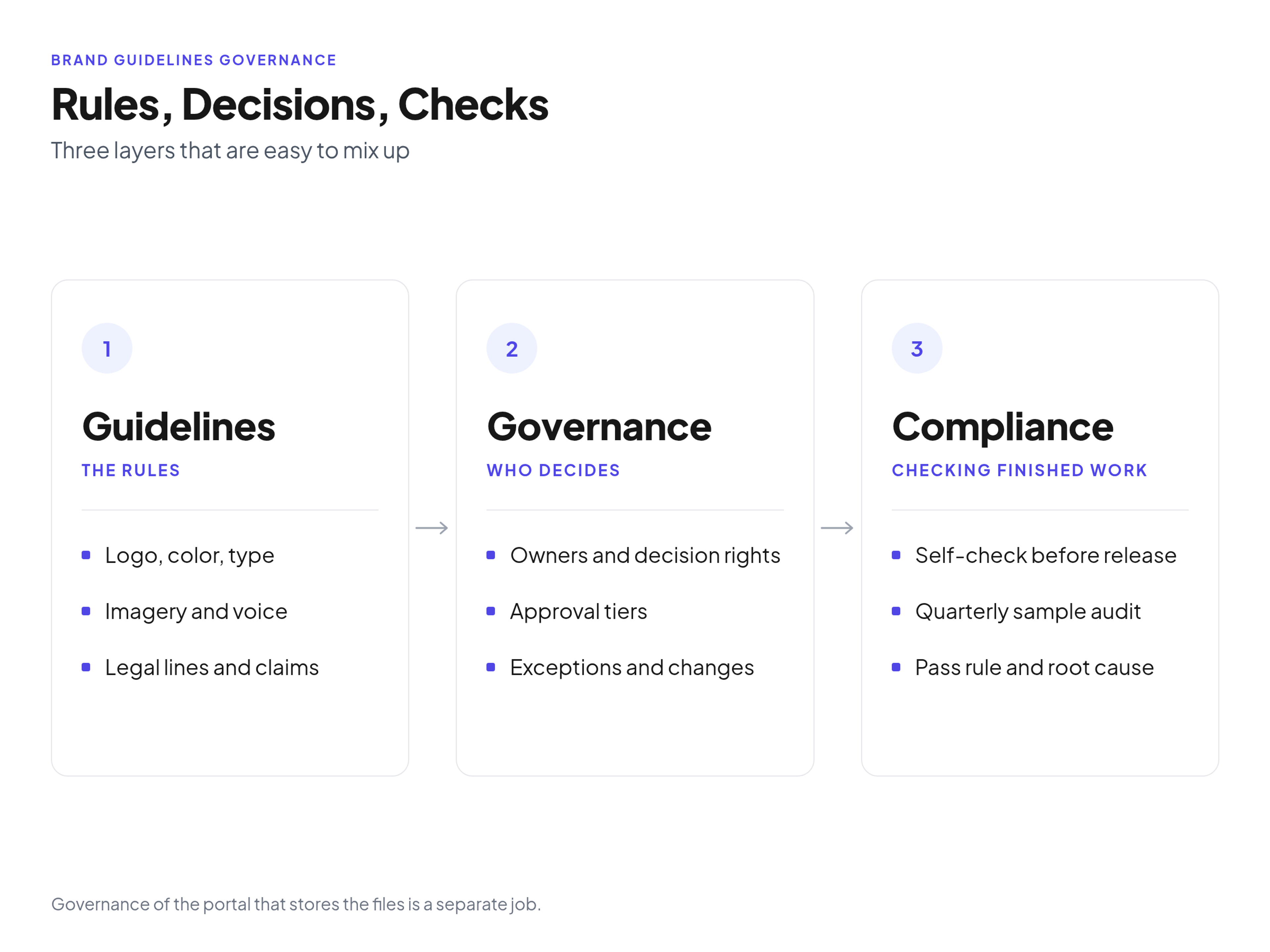
Diagram: guidelines are the rules, governance is who decides, and compliance is checking finished work against the rules.
Brand guidelines vs brand governance vs brand compliance
Guidelines are the rules, governance is who decides what happens to those rules, and compliance is checking finished work against them. Keeping the three apart tells you which problem you actually have.
Brand guidelines are the documented rules for logo use, color, type, imagery and tone of voice. They are the static rulebook, and a rulebook does not enforce itself.
What is brand governance? In plain terms, it is the operating system around the rules: who owns each part, who answers interpretation questions, who can grant an exception, who approves a change, and how work is reviewed before it ships. The pages I read describe it the same way, as the system that enforces the guidelines through approvals, training and audits.
Brand compliance is the checking: do finished ads, decks, posts and partner materials actually follow the rules? It is the evidence that tells you whether governance works.
If the same question keeps coming back, you have an ownership gap. If the rule is clear but work still ignores it, you have a compliance gap, often caused by a missing template or an outdated file. Governance of the portal itself is a separate job. For roles, upload approvals and access reviews inside a brand portal, read that article. This one stays on the guidelines and on finished work.
Who decides what: roles and decision rights
Give every part of the guidelines a named owner and write down four decisions for it: who writes it, who interprets it, who can grant an exception, and who approves a change. Once that list exists, "who can say yes?" stops being a debate.
Start with the roles:
- Guideline owner, plus a deputy. Accountable for the guidelines as a whole. In a typical team that is the head of marketing or the senior brand manager. The deputy keeps decisions moving when the owner is out.
- Section owners. One named person per guideline part. They write their part and answer questions about it.
- Legal or compliance reviewer. Owns the legal lines and reviews claims, comparisons, testimonials and regulated wording.
- Regional or partner marketing leads. Adapt the rules for a market or partner. They can request exceptions and propose local changes, but they do not approve their own exceptions.
- Everyone who uses the guidelines. Employees, agencies and contractors follow the rules, run the self-check and ask when unsure.
Iron fist or lean?
Frontify's brand governance guide contrasts two models. In the "iron fist" approach, the brand manager is the sole guardian. That brings review delays, and off-brand work still happens when teams use outdated guidelines. In the "lean" approach, the brand team educates and hands guardianship to the teams. My view: most teams need a lean default with a few owner-only decisions. I'd keep those owner-only decisions as few as I could, and let section owners and the people closest to the work decide the rest.
Decision rights per guideline part
Here is a starting point. Swap in your own titles, but keep all four decisions on every row.
- Logo and identity: written and interpreted by the section owner. Exceptions and changes are decided by the guideline owner, because logo rules touch everything else.
- Color and typography: written and interpreted by the section owner. The section owner grants exceptions within a stated scope, such as a print vendor that cannot match a color. Changes are approved by the section owner, with the guideline owner informed.
- Voice and messaging: written and interpreted by the section owner. Exceptions for tone and style sit with the section owner. Anything that changes a claim goes to the legal or compliance reviewer. Changes are approved by the guideline owner, since messaging shifts positioning.
- Photography and imagery: written, interpreted and granted exceptions by the section owner. Changes are approved by the section owner, with the guideline owner informed.
- Templates: written and interpreted by the section owner. Exceptions are granted by the section owner. Changes are approved by the section owner, except changes to a locked logo or legal element, which go to the guideline owner.
- Legal lines and claims: written by the legal or compliance reviewer together with the voice and messaging owner. Interpreted by the legal reviewer. Only the legal reviewer grants exceptions or approves changes.
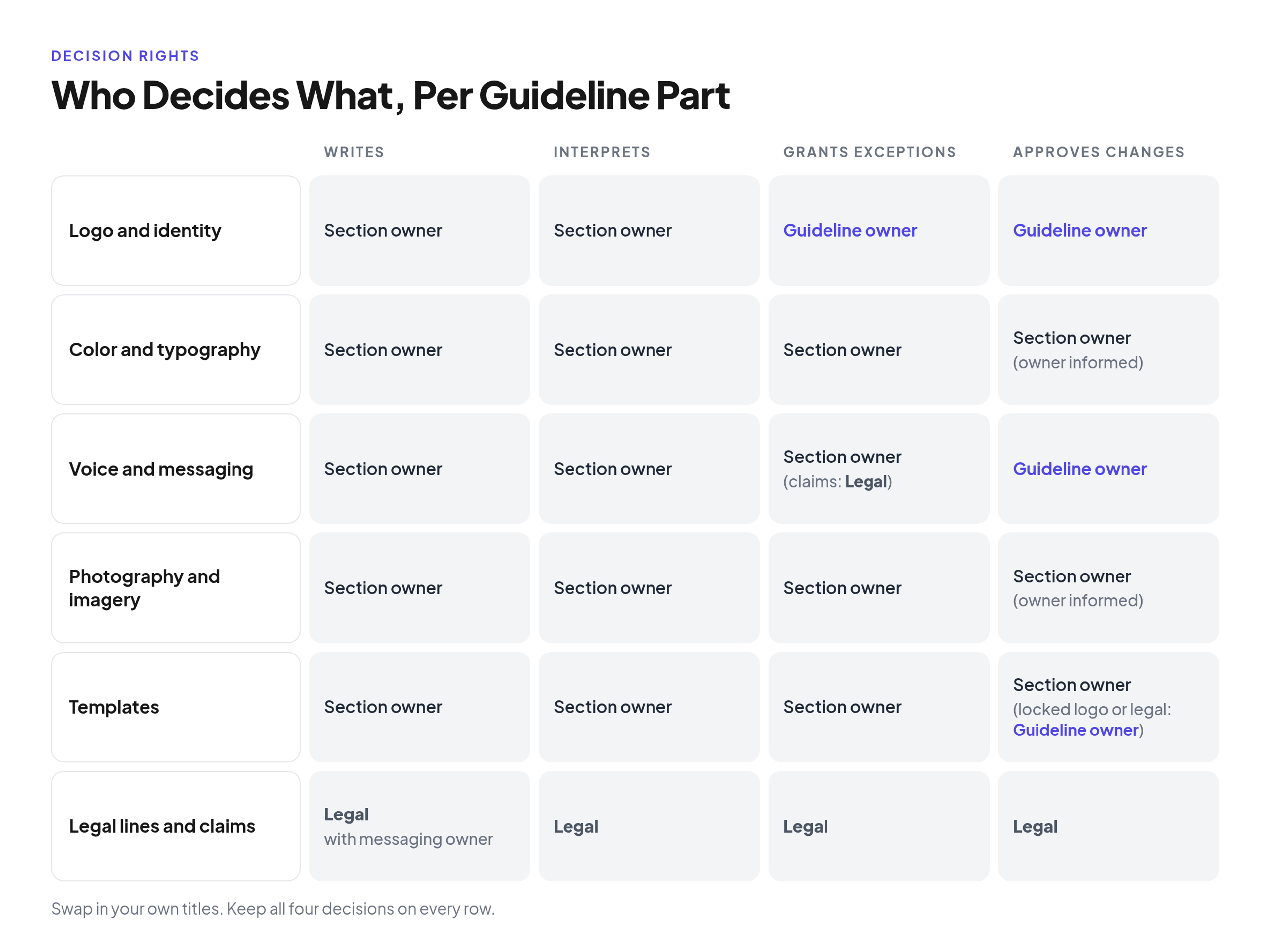
Decision-rights matrix: for each guideline part, who writes it, who interprets it, who grants exceptions and who approves changes.
Put this list inside the guidelines themselves, so a freelancer can find "who do I ask?" in one place.
Approval by risk of the asset or claim
Match the review to the risk of the finished work, using a few tiers with one named approver each. A post built from an approved template should not wait in the same queue as a new product claim.
These tiers cover finished work: ads, decks, posts and partner materials. Marq's brand governance guide makes the same basic point. Legal language, regulated claims and high-visibility messaging need strict review, while low-risk content built from approved templates can move faster. Here is one way to set it up:
- Tier 1, self-check only. Built from a locked, approved template with no new claims. The creator runs the short self-check and publishes.
- Tier 2, section owner or brand team review. A new layout or new imagery that stays inside the rules.
- Tier 3, brand plus legal review. New claims, comparisons, prices, testimonials, endorsements or regulated wording.
- Tier 4, guideline owner decision. Logo changes, co-branding, new sub-brands, or anything that bends a core rule.
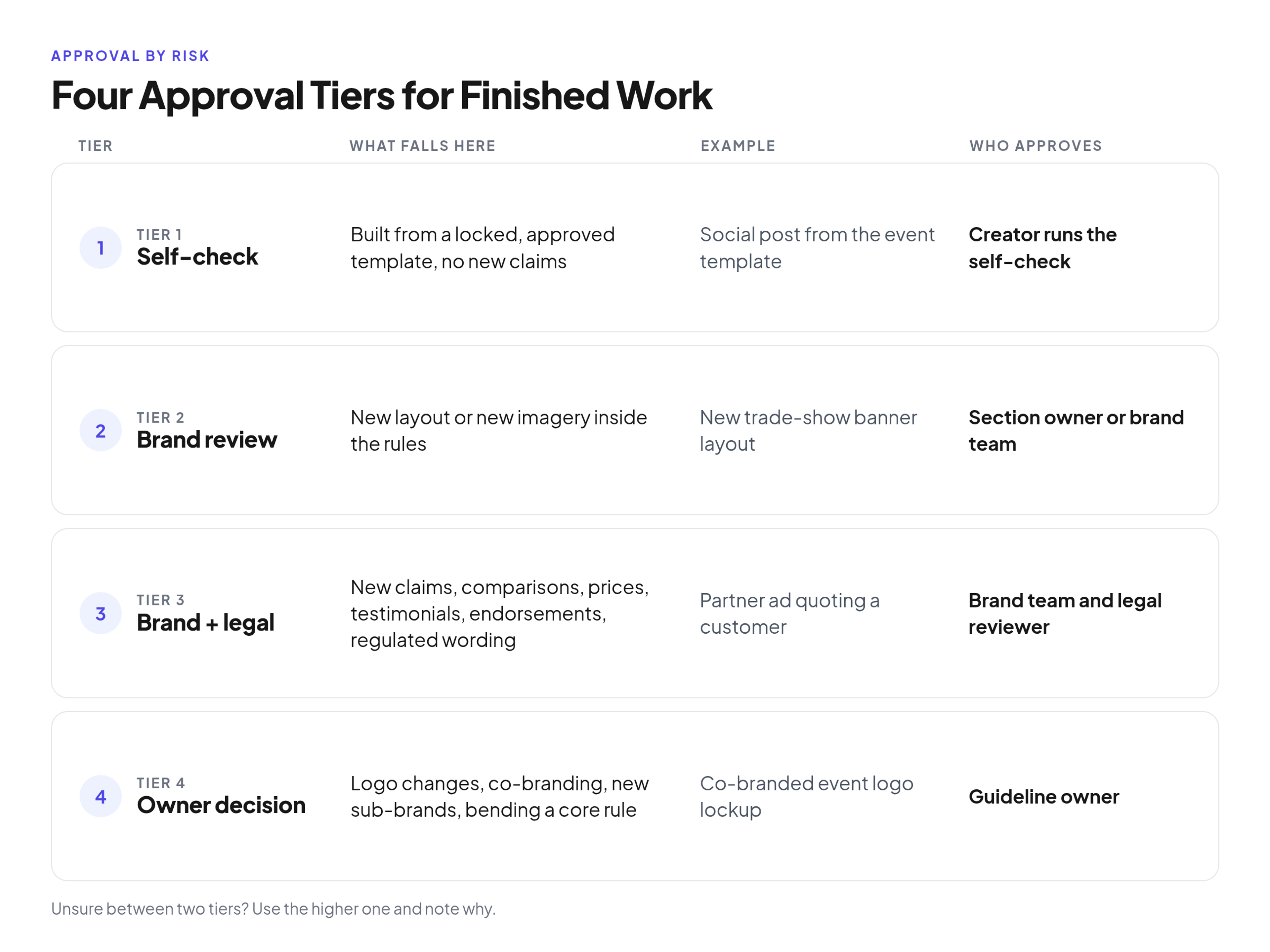
The four approval tiers for finished work, each with an example and the approver.
I'd keep Tier 1 as large as your template set allows, because that is where the speed comes from, and keep Tier 4 as small as possible. When a piece could fit two tiers, send it to the higher one and note why. Over time those notes show you which template or rule is missing.
Tier 3 exists because some wording carries legal risk, not only brand risk. The FTC's advertising FAQ guide for small business says a company needs a "reasonable basis" for its ad claims before it runs the ad, meaning objective evidence that supports the claim. A money-back guarantee is not a substitute for that substantiation. For testimonials and endorsements, the FTC's Endorsement Guides Q&A says that a connection between an endorser and the marketer should be disclosed clearly and conspicuously if a significant minority of consumers wouldn't expect it and it would affect how they evaluate the endorsement. The FTC revised the Endorsement Guides in 2023. This is not legal advice. Your legal reviewer decides what evidence and wording are enough.
Exceptions and interpretation questions
Give people one place to ask "is this allowed?" and one written record for every exception, with an expiry date. Without both, rules get bent in chat threads and nobody can tell which bends were approved.
Start with questions. Pick one intake route, such as a shared inbox, a channel or a simple form. The person named as interpreter for that guideline part answers, and the answer gets logged. If the same question returns, the rule is unclear: fix the wording or add a visual example.
For exceptions, on Marq's guide I found "number of governance exceptions" listed as a metric, but no process for asking for or granting one. You cannot count exceptions you never recorded. A short exception (waiver) record is enough:
- Who asked.
- Which rule the request bends.
- Why it is needed.
- Scope: channel, market and asset.
- Approver, as named in the decision-rights list.
- Expiry date, usually the end of the campaign or the day the asset is retired.
An exception with no expiry date is a silent rule change. Review open exceptions at every audit and close the ones that have run out.
Then add one rule: the same exception requested repeatedly becomes a proposed guideline change. Suppose several regional teams each ask for a different secondary color in print. That is a signal the rule does not fit the work, and approving it again and again just hides the problem. Once the owner approves the change, release it as described in our article on versioning and releasing a guideline change.
Make correct use the easy path
People mostly break rules because the right file or template is hard to find. Give them one current source, templates for the most frequent jobs and examples beside each rule, and enforcement gets lighter.
A common pattern is old PDFs and "final" files sitting in inboxes and shared drives, with people grabbing whatever is closest. These habits help:
- One current source for the guidelines, so nobody works from an old copy.
- Locked templates for the most frequent jobs. This is what makes Tier 1 possible.
- Correct and incorrect examples directly beside each rule.
- A short self-check list that people run before Tier 1 or Tier 2 work goes out.
- A line on what changed each time a rule is updated, and a short onboarding for new hires, agencies and freelancers.
One example of keeping a single current source is an online brand guidelines and asset library such as brandportal.to, which puts the guidelines and the asset library in one place. It supports public or password-protected portals, folders, version history, share links, Admin, Editor and Viewer roles, and unlimited free viewers. If your rules still live in a PDF, see turning a PDF brand book into a living web page.
How to audit and measure compliance
Audit finished work in the field with a quarterly sample, a short checklist and a pass rule you set in advance. Checking the master files in your library tells you little about what actually reaches customers.
Marq's guide recommends auditing live content in the field. I'd add a fixed sample and a written pass rule, so results can be compared from one quarter to the next.
The sample and the checklist
Pick a fixed number of recent items per channel and per team: sales decks, social posts, partner materials, event materials. Choose a number your team can review in an afternoon and keep it the same each quarter. For general principles of auditing and running an audit program, ISO 19011 on auditing management systems is the usual reference. It is not a certification standard, and it does not cover brands, so borrow the discipline of planned, evidence-based audits rather than the content.
Check each sampled item against a short list:
- Current logo version and clear space.
- Colors.
- Type.
- Approved imagery.
- Current messaging and claims.
- Legal lines and disclosures.
- Contact details.
Score each item pass, minor issue or fail. Then set the pass rule in the charter before you pull the first item. For example: an item passes only with no fail-level issue. Your team can pick a stricter or looser rule, but write it down so quarter two is scored the same way as quarter one.
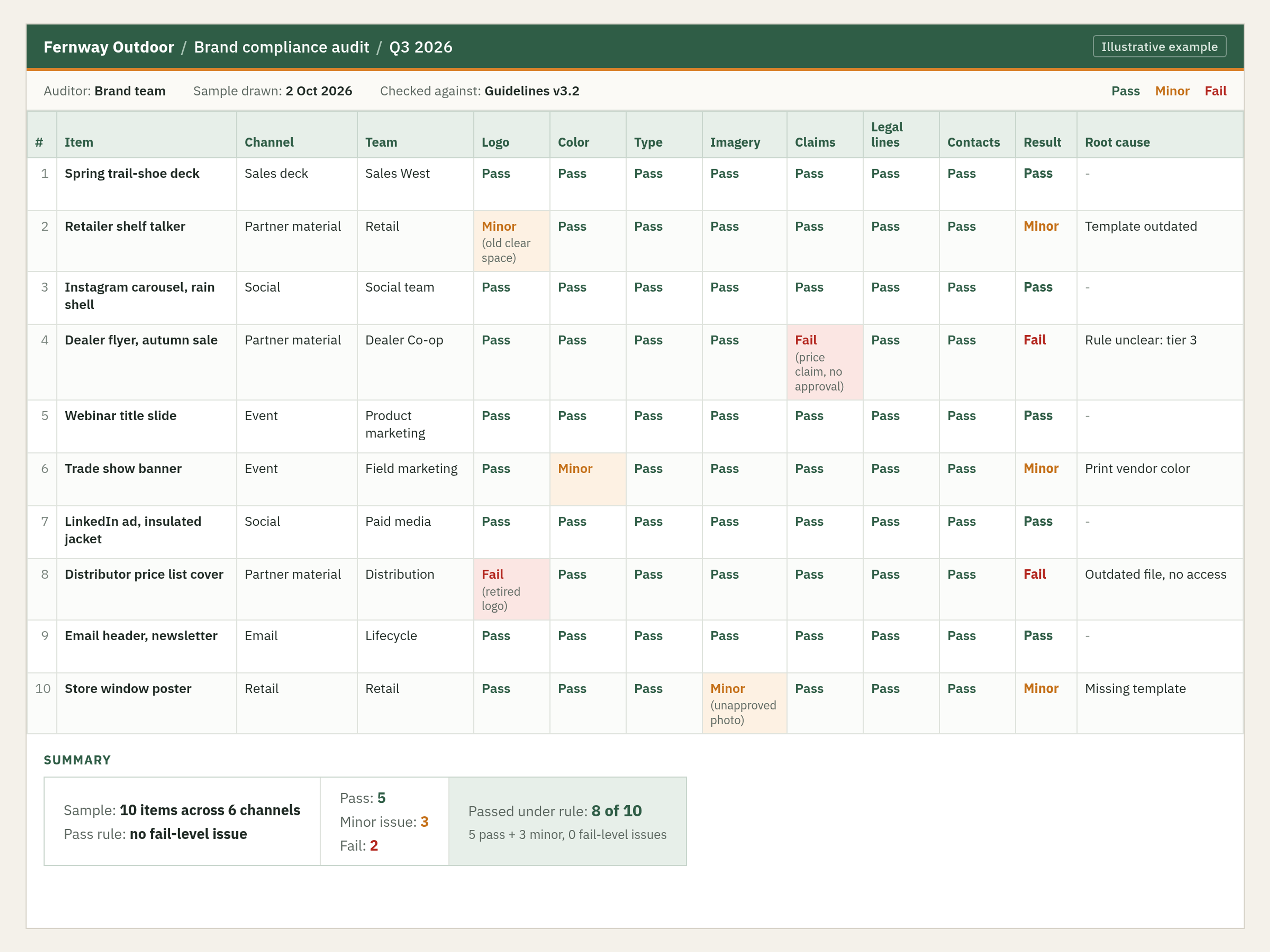
Illustrative example: quarterly audit scorecard for the fictional outdoor-gear company Fernway Outdoor, with sampled items scored pass, minor issue or fail.
Root cause before blame
For every fail, ask why it happened. Was a template missing? Was the rule unclear? Was the person working from an outdated file? Did they lack access to the current one? Fix the cause first. The pattern usually points to a governance gap, not a careless person.
Metrics worth tracking
- Share of sampled items that pass.
- Approval turnaround, by tier.
- Open exceptions and their age.
- Repeat questions per rule.
- Requests for basic files.
Marq's guide lists similar metrics, including approval turnaround time, asset compliance rate, number of governance exceptions and ticket or request volume. The addition here is the sample and the pass rule, which make the pass share comparable over time. There is no universal benchmark for it, so treat your first quarter as the baseline.
A one-page guidelines governance charter
Put the governance decisions on one page and place it at the front of the guidelines, so owners, tiers, exceptions and audits are written down once. This charter is for the guidelines, not for portal access.
Fields to include:
- Purpose and scope of the guidelines.
- Guideline owner and deputy.
- Section owners.
- Decision-rights summary: who writes, interprets, grants exceptions and approves changes for each part.
- Approval tiers, with examples and approvers.
- Exception process and expiry rule.
- Where interpretation questions go, and the response target your team sets.
- Audit cadence, sample size, checklist and pass rule.
- How approved changes are released.
- Review date for the charter itself.
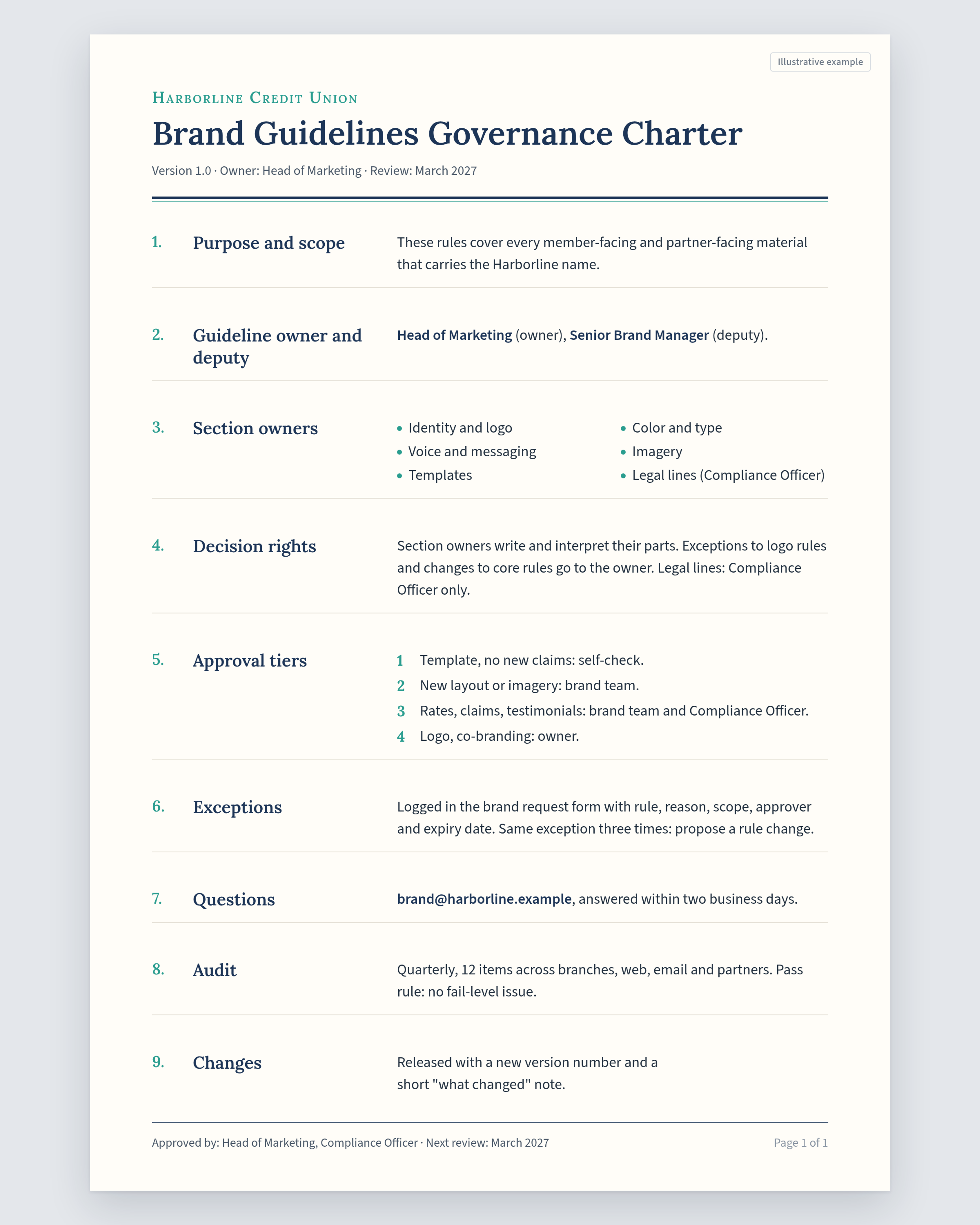
Illustrative example: one-page guidelines governance charter for the fictional Harborline Credit Union.
Common mistakes
Most governance problems come from unclear ownership and missing records, not from careless staff. Watch for these patterns:
- One person reviews everything. The queue grows, and people start publishing without review.
- Guidelines without an owner or deputy. Nobody updates the rules, and nobody is sure who may.
- Exceptions granted in chat and never recorded. Months later, someone copies the waived design and assumes it is the standard.
- Auditing only the master files. The library can be perfect while the field uses old decks.
- No pass rule. If the rule changes each quarter, the trend means nothing.
- Blaming creators for template gaps. If the central team never provided the template, the fix is a template, not a reprimand.
FAQ
What is brand governance?
It is the system that decides who owns the brand rules, who answers questions about them, who can approve exceptions and changes, and how finished work is reviewed and checked. Guidelines are the rules, and governance is how those rules are owned and applied.
What are the four P's of governance?
There is no single official list, and lists vary by source. A practical reading for brand guidelines, offered as a way to think about it rather than a standard, is people (owner, section owners, reviewers), purpose (what the guidelines cover and why), process (questions, approvals, exceptions, changes) and performance (audits and metrics).
What are the 5 C's of branding?
Lists differ by source, so I wouldn't treat any single version as the standard. Consistency is the part governance protects, whichever list you use.
What is the 3-7-27 rule in branding?
It is an informal marketing rule of thumb about repeated exposure to a brand. Versions differ, and it is not a research standard, so don't build a plan around its numbers. The useful takeaway is that every exposure should look and sound like the same company, which is what consistent rules and checks are for.
Who should own brand guidelines?
One accountable person with a named deputy. In a typical team that is the head of marketing or the senior brand manager. Section owners handle their parts, and the legal or compliance reviewer owns legal lines and claims. Ownership by committee often means nobody answers.
How often should you audit brand compliance?
I'd start with a quarterly sample audit of finished work, which is usually frequent enough to catch drift without becoming a project. Adjust it to how much work your teams produce, and consider an extra sample after a major launch or rebrand.
Conclusion
Start small. Name the guideline owner and a deputy, write the decision-rights list for the six guideline parts, adopt the four approval tiers and start an exception record with expiry dates. Then schedule your first sample audit and write the pass rule before you pull the first item. If you want the guidelines and the files in one place while you do it, see plans and the 14-day free trial. Paid plans also carry a 30-day money-back guarantee.