To build a brand portal business case, measure what today's file requests and rework cost, compare options with full costs, propose a pilot and ask for one decision. Each step produces something a budget owner can check.
Budget owners rarely reject brand consistency as an idea. They reject requests they can't evaluate. A feature list (tagging, version history, share links) says what a product does. It doesn't say what the company gets, what it costs in total or who will run it. Your own counts answer those questions before anyone asks.
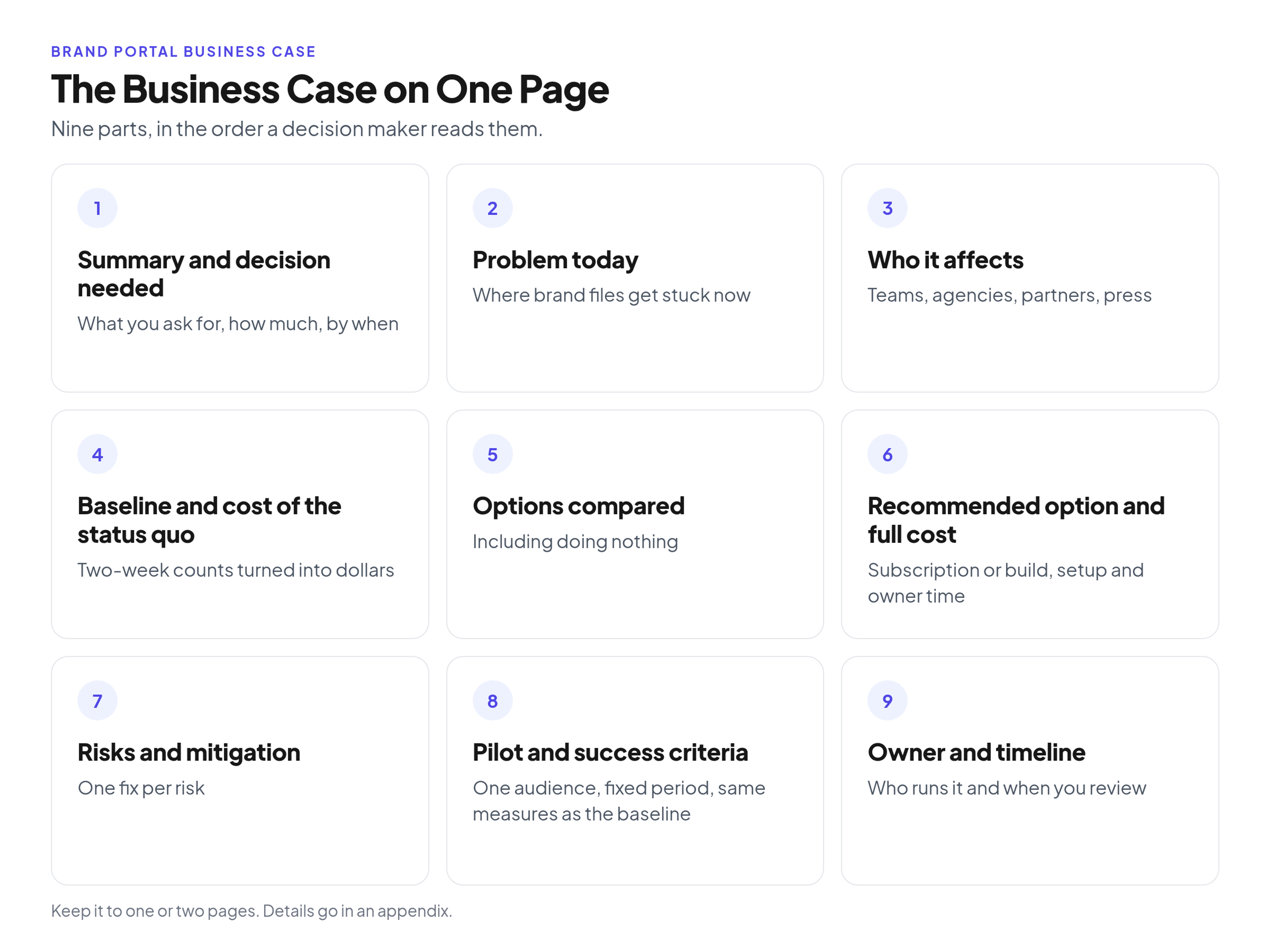
The business case on one page: the parts a decision maker expects, in the order they read them.
What a brand portal business case is and who reads it
A business case justifies spending by weighing the benefit, cost and risk of the alternatives. For a brand portal, it fits on one or two pages written for the budget owner.
The Association for Project Management defines a business case as the justification for undertaking a project, programme or portfolio: it evaluates the benefit, cost and risk of alternative options and provides a rationale for the preferred solution (APM, "What is a business case?"). Here are APM's five elements, cut to a line or two each:
- Strategic context: why the problem matters now (a launch, a rebrand, new partners or markets).
- Economic analysis: the options and what each costs and returns, including doing nothing.
- Commercial approach: how you would get it, by subscribing or building in-house.
- Financial case: the year-one total cost and the status-quo cost it is compared with.
- Management approach: the owner, the pilot and the review date.
APM also notes that "it is normal practice to include the 'do-nothing' option as a reference" and that "the sponsor owns the business case." For a marketing purchase, the sponsor is usually the CMO or department head whose budget pays, even if a brand manager drafts the document.
What you're asking to fund is a brand portal: one place for online brand guidelines and the brand asset library. You can build it in-house or buy it as a service such as Brandportal.
Who gains, by audience
Six groups usually gain: internal marketing and design, sales, regional teams, agencies and freelancers, resellers and partners, and the press. List the ones that apply. Each becomes a line under "who it affects."
- Internal marketing and design. They answer file requests between real tasks. Interruptions pile up, and nobody is sure which version is current. Once approved files are uploaded, colleagues help themselves.
- Sales. Reps reuse a local copy of a deck for months. After a rebrand or new legal copy, the old version keeps going out. A portal lets them pull the current deck each time.
- Regional teams. They adapt global campaigns. When they can't find source files, they rebuild assets locally and the rules slip. A portal keeps source files and guidelines side by side.
- Agencies and freelancers. They get attachments or expiring links and sometimes work from an old brand book. Access to the current guidelines and files ends the "which version?" email thread.
- Resellers and partners. Someone zips product images by hand for each partner, and does it again whenever the range changes. A partner view lets them download what they need.
- Press. Journalists need logos and headshots on deadline. If the reply is slow, a low-quality logo from a web search gets used instead. A public media section removes the request.
For the full list, see what changes day to day once people stop emailing for logos.
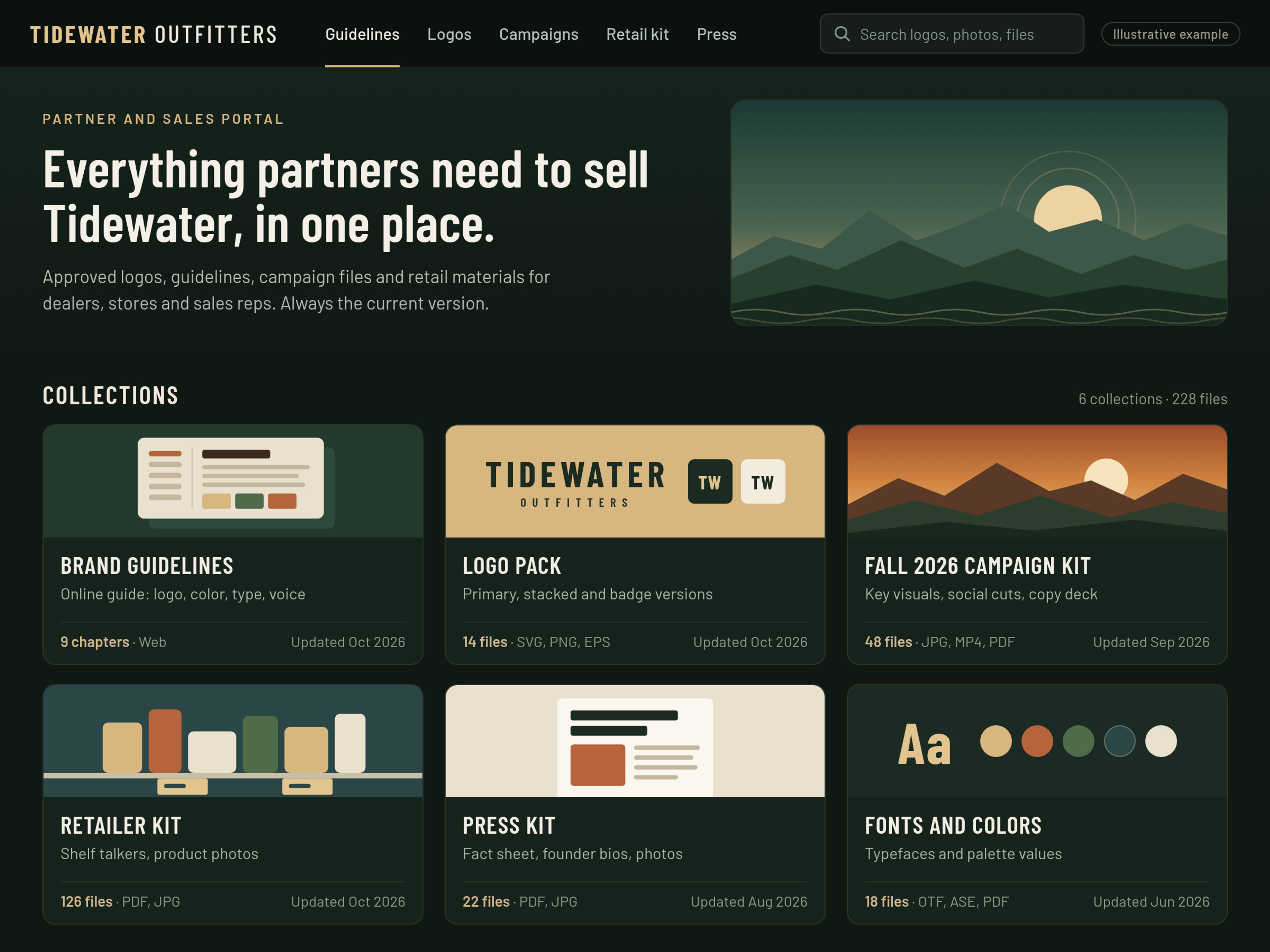
Illustrative example: what partners and sales would see in a portal for a fictional outdoor brand, Tidewater Outfitters. Names and data are invented.
Measure the status quo with a two-week baseline count
For two working weeks (ten working days), count asset requests, handling time, search time and rework, using a shared inbox label and a tally sheet. The result is your own number, which a budget owner can check.
What to count:
- Requests for logos, fonts, templates, color codes, product images and decks, and who asked.
- Minutes spent answering each one: finding the file, checking it's current, sending it.
- Time requesters spend searching on their own before they ask.
- Rework hours caused by outdated or off-brand files, or by redoing work that already existed (a corrected slide, a rebuilt banner).
- Large files emailed to partners and share links that expired before anyone used them.
- Any case of licensed fonts or images used outside their license.
How to count:
- Label every asset request in the shared marketing inbox for the two weeks.
- Keep a tally sheet, with minutes, for requests that come by chat or in person.
- Ask three heavy requesters (say, a sales lead, a regional marketing lead and a senior designer) to note their own searches and waits.
Pick two ordinary weeks and don't inflate anything. If the weeks were quieter than usual, say so rather than adjusting the numbers. One implausible figure makes a reviewer doubt every line.
Turn the count into a cost
Multiply weekly handling hours by a loaded hourly cost and the number of working weeks, then add rework. For the illustrative Larkfield Coffee Co., that comes to $17,160 a year.
The formula:
- Handling hours per week = requests per week × minutes per request ÷ 60
- Annual handling cost = handling hours per week × loaded hourly cost × working weeks
- Annual rework cost = rework hours per month × loaded hourly cost × 12
- Status-quo cost = annual handling cost + annual rework cost
A loaded hourly cost includes benefits, not just wages. The U.S. Bureau of Labor Statistics reports that in June 2026, employer costs for private industry workers averaged $46.89 per hour worked. Wages made up 70.0% of that and benefits 30.0%. For full-time private industry workers, the average was $54.00 (BLS, Employer Costs for Employee Compensation). If your finance team has a standard rate for internal cases, use theirs instead.
Illustrative example: Larkfield Coffee Co.
Larkfield is a fictional coffee company, and every input is invented. Its two-week count showed 25 requests a week at 12 minutes each, plus 6 hours of rework a month. The loaded rate is $55 an hour (close to the BLS $54.00), over 48 working weeks.
- Handling time: 25 × 12 ÷ 60 = 5 hours a week
- Handling cost: 5 × $55 × 48 = $13,200 a year
- Rework cost: 6 × $55 × 12 = $3,960 a year
- Status-quo cost: $13,200 + $3,960 = $17,160 a year
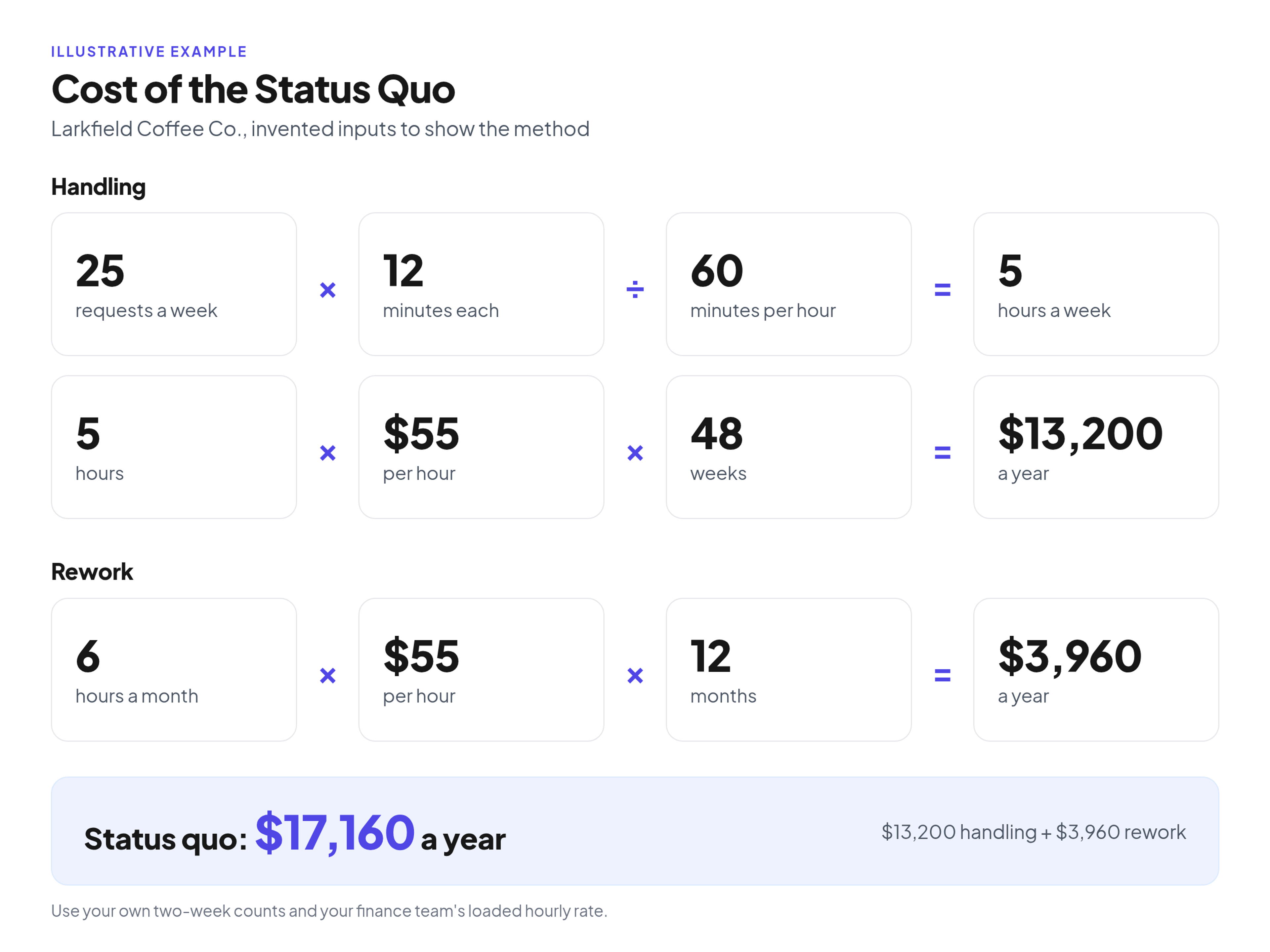
Illustrative example: the status-quo cost formula with Larkfield Coffee Co.'s invented inputs. Use your own two-week counts.
This figure leaves out requesters' own search time, which keeps it conservative. Some benefits can't be priced from the count, such as faster launch prep or fewer license problems. List those as plain statements.
Compare four options, including doing nothing
Lay out four options and give the same five facts for each: one-time cost, recurring cost, who maintains it, what it fixes and the main risk. Price them from real quotes, plan pages and hour estimates from whoever would do the work.
Do nothing
- One-time cost: none.
- Recurring cost: your status-quo cost ($17,160 a year in the Larkfield example).
- Who maintains it: everyone, by hand, one request at a time.
- What it fixes: nothing. It's the reference point for every other option.
- Main risk: the cost stays invisible and grows with each new partner, market or launch.
Tidy the shared drive and the PDF brand book
- One-time cost: internal hours to restructure folders, remove duplicates and update the PDF.
- Recurring cost: someone's time to keep folders clean and reissue the PDF after every change.
- Who maintains it: a named marketing or brand manager.
- What it fixes: findability for internal staff, at least for a while.
- Main risk: emailed copies of the PDF go out of date, the rules sit apart from the files, and outside access stays awkward.
Build in-house on the intranet or website
- One-time cost: design and development hours, plus content setup.
- Recurring cost: hosting, maintenance, and IT or web team time for each change.
- Who maintains it: IT or the web team, with marketing supplying content.
- What it fixes: one central destination you fully control.
- Main risk: marketing updates queue behind other IT priorities, and the site drifts out of date.
Subscribe to a brand portal service
- One-time cost: setup time for the asset audit, guidelines, tagging, permissions and migration.
- Recurring cost: the subscription plus monthly owner time.
- Who maintains it: the brand or marketing team.
- What it fixes: guidelines and approved files sit in one place that marketing can update without a developer, for internal and external audiences.
- Main risk: low adoption, or a service more complex than the team needs.
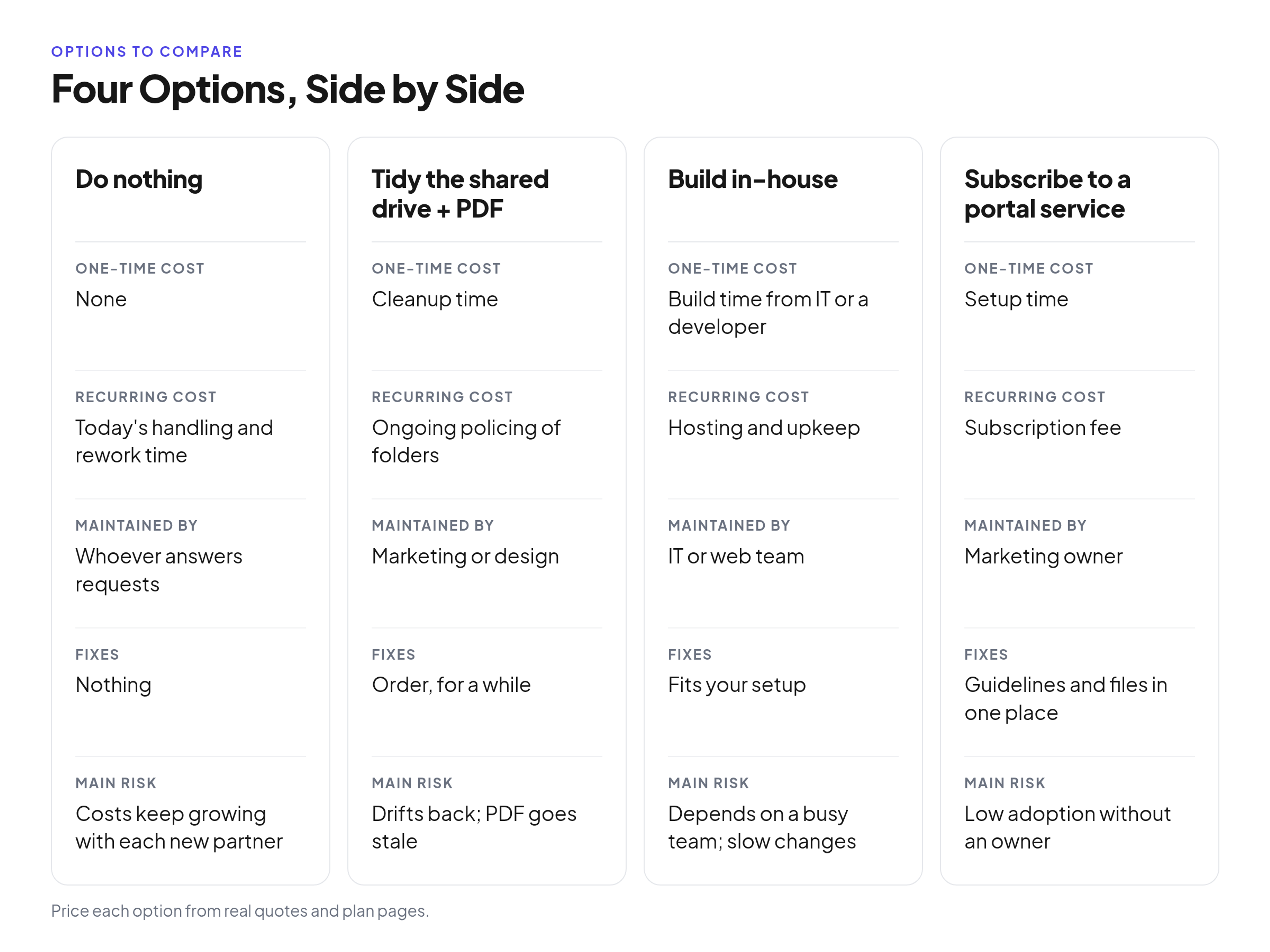
Four options a decision maker will expect to see side by side, including doing nothing.
If your status-quo cost is small, tidying the drive may win. Let the numbers pick the option.
Count the full investment
The investment is the subscription or build cost plus setup, owner time, training, migration and renewals. In the illustrative Larkfield example below, setup time is the biggest hidden cost, so estimate it in hours.
Include:
- The subscription or build cost, and renewal terms beyond year one.
- The asset audit: reviewing files, deleting duplicates and old versions, deciding what moves.
- Putting the guidelines online as pages, not as a PDF upload.
- Basic tagging, metadata, permissions and roles for internal and external groups.
- Migrating the files that survive the audit.
- Training for editors and a short walkthrough for everyone else.
- Monthly owner time for new campaign files, access requests and retiring old versions.
Illustrative example: Larkfield's year-one total
- Subscription quoted at $948 a year (Brandportal Professional, billed annually at $79 a month)
- Setup: 30 hours × $55 = $1,650
- Owner time: 2 hours a month × $55 × 12 = $1,320
- Year-one total: $948 + $1,650 + $1,320 = $3,918
Here, setup and owner time together cost more than the subscription. A budget showing only the $948 would hide most of the year-one cost.
The break-even share
Break-even share = year-one total cost ÷ annual status-quo cost. For Larkfield: $3,918 ÷ $17,160 = about 23%.
In plain terms, the portal pays for itself in year one if it removes roughly a quarter of today's handling and rework time. This is not a forecast. It's a threshold, and the pilot checks whether it's realistic.
What if your year-one cost comes close to your status-quo cost? Then time savings alone can't carry the case. Say so, and either argue on risk and consistency or wait.
Risks and how you handle them
Name five risks in the case, each with one mitigation. A budget owner trusts a document that points out its own weak spots.
- Low adoption. Agree before launch that the team answers file requests with a portal link, not an attachment. For the longer playbook, see how to get teams and partners using it after launch.
- No owner. Name one person in the document, with monthly hours set aside for the job.
- Outdated files moved over. Audit before migration, and archive old versions instead of moving them.
- Licensed fonts and images shared beyond their license. Check license terms during the audit, and keep restricted files where only the right roles can open them.
- Partner access too broad. Give partners a separate portal or share links to specific folders, not the whole library.
Governance (who publishes, approves and grants access, and how you track usage) can wait for a short note of its own. The case needs a named owner.
Propose a pilot with success criteria
Ask for a pilot, not a full rollout: one audience, a defined set of files, a fixed period (30 to 60 days is a sensible range) and measures that mirror your baseline. End it with a review date and a decision.
- Audience: one group with heavy, repetitive requests, such as wholesale partners and one agency.
- Files: a defined set, for example the current deck, the logo pack and core product images.
- Period: fixed, with start and review dates in writing.
- Measures: the same as in the baseline: requests per week from the pilot group, minutes spent handling them, rework hours and partner turnaround.
- Method: repeat the two-week baseline count over the pilot's last two weeks, with the same label and tally sheet.
- Success threshold: the pilot group's handling and rework time falls by more than the break-even share (about 23% for Larkfield).
- Decision: at the review, the budget owner chooses to roll out, adjust or stop.
The one-page outline
Copy these nine sections into a blank document. Fill each with two or three lines of your own numbers, and put the decision first.
- Summary and decision needed
- Problem today
- Who it affects
- Baseline and cost of the status quo
- Options compared
- Recommended option and full cost
- Risks and mitigation
- Pilot plan and success criteria
- Owner and timeline
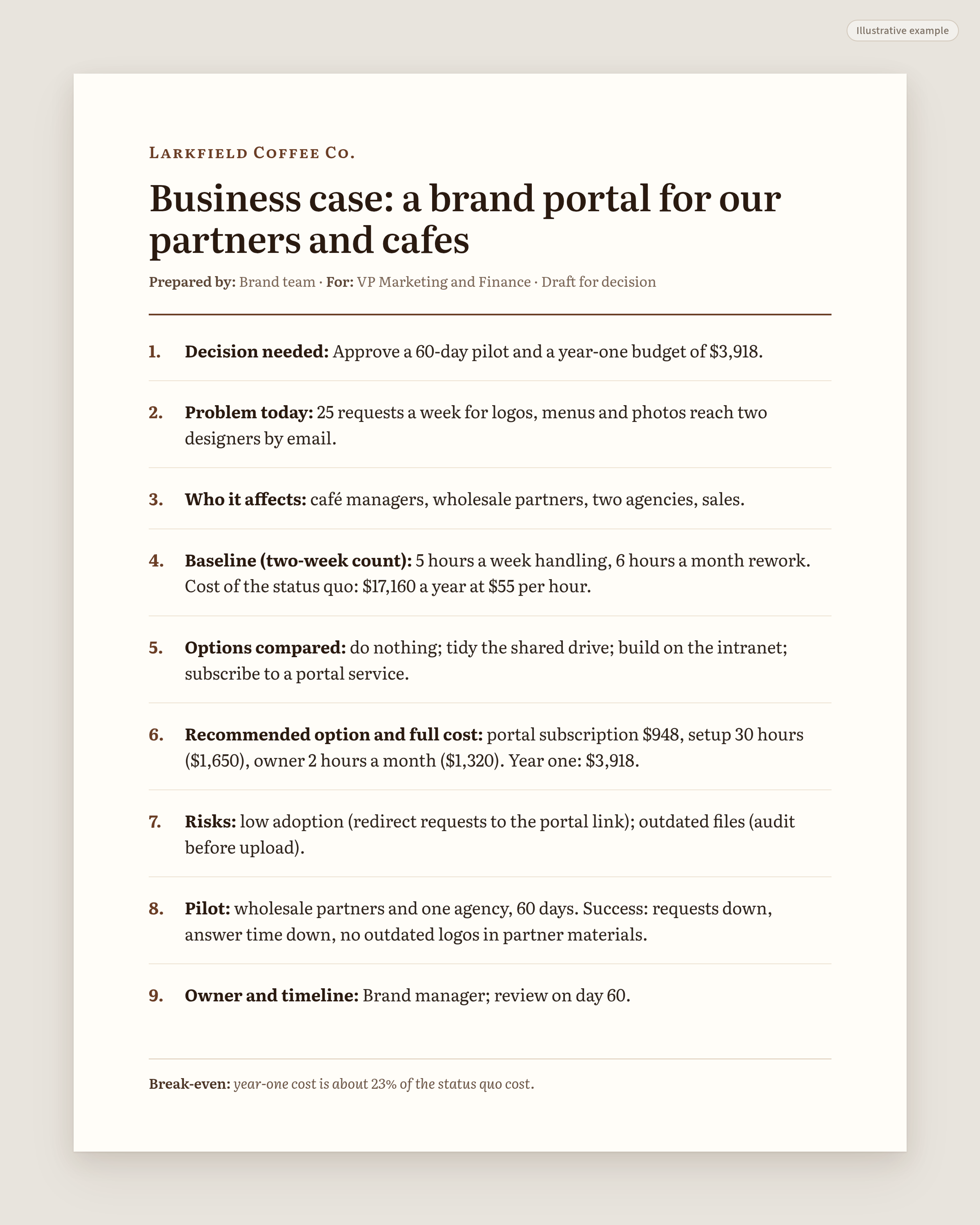
Illustrative example: a one-page business case for a fictional coffee company, Larkfield Coffee Co. Names and figures are invented.
In the illustrative Larkfield version, the summary asks for two things: a 60-day pilot with wholesale partners and one agency, and a year-one budget of $3,918. It sets them against a status-quo cost of $17,160 a year. Section 6 shows the full year-one total, not just the $948 subscription. A footer line sets the 23% break-even share as the pilot's bar.
How to present it
A CMO or finance lead is likely to ask five questions, so prepare a one-line answer to each from your own numbers. Show the status-quo cost next to the year-one cost, and don't promise a return.
- Why now? "We have [a launch, a rebrand, new partners] coming, and each adds requests to a process we've already measured."
- What if we do nothing? "We keep paying the status-quo cost from our own two-week count ($17,160 a year in the Larkfield example)."
- What does it cost in year one and after? "Year one is $3,918 all in, including setup (Larkfield's illustrative figure). After that, the subscription and owner time continue, and setup doesn't."
- Who owns it? "[Name] runs the portal with [hours] a month set aside; [sponsor] owns the business case."
- How will we know it worked? "We repeat the two-week count at the end of the pilot and roll out only if the drop beats the break-even share."
Bring the tally sheet as backup, so you can show where any input came from.
Common mistakes
Six mistakes are easy for a budget owner to spot: features first, borrowed statistics, subscription-only costs, no owner, no baseline and asking for everything at once. Each has a one-line fix.
- Leading with features. Put the decision and the status-quo cost first.
- Borrowed statistics nobody can check. A widely quoted figure about time lost to searching invites the question "is that true here?" Your own count answers it.
- Counting only the subscription. In the Larkfield example, setup and owner time cost more than the subscription. Cost every hour.
- No owner. Without a named person and protected time, the library goes stale. Name one.
- No baseline. Without one, the pilot review has nothing to compare against. Count first.
- Asking for everything at once. Every audience on day one raises both risk and price. A pilot lowers both.
FAQ
These short answers cover the questions that usually follow the one page. You can reuse them in your own document.
What should a brand portal business case include?
Nine parts, on one or two pages: summary and decision needed, problem today, who it affects, baseline and status-quo cost, options compared (including doing nothing), recommended option and full cost, risks and mitigation, pilot plan and success criteria, and owner and timeline.
How do you calculate the ROI of a brand portal?
Compare the annual status-quo cost from your two-week baseline count with the year-one total cost (subscription or build, setup, owner time, training). Divide the year-one cost by the status-quo cost to get the break-even share. That's how much of today's handling and rework time the portal must remove to pay for itself in year one. Then measure the pilot against the baseline. Treat the share as a threshold to test, not a promised return.
How much does a brand portal cost?
It depends on seats, storage and the number of portals, plus setup and owner time. As one reference point, Brandportal's plans, billed annually, run from $15 a month (Starter: 1 portal, 2 admin or editor seats) to $79 a month (Professional: 5 portals, 5 seats), with Enterprise from $499 a month. Check current pricing, and get quotes for anything else you compare.
Who should approve a brand portal purchase?
The budget owner: whoever holds the budget it comes from, usually a CMO, marketing director or department head, sometimes with a finance lead signing off. APM's guidance is that the sponsor owns the business case, so agree early on who the sponsor is. The person drafting the case often isn't.
Do we need a brand portal if we already have a shared drive or a DAM?
Not always. If your two-week count shows few requests and no regular outside users, a tidied shared drive and a current brand book may be enough. A portal helps more in three cases: agencies, partners or press need files, guidelines and files belong together, or a DAM is too complex for occasional users. Then a portal can replace the drive for brand files, or sit alongside the DAM as the place most people get approved assets.
Conclusion
Build the case from your own two-week count, compare four options with full costs, and ask for one decision: a pilot with a clear threshold. That turns "we need a brand portal" into a request a budget owner can decide on the numbers.
For Larkfield (illustrative), the status quo costs $17,160 a year, year one costs $3,918, and the break-even share is about 23%. Your inputs will differ, but the method won't.
Once the decision is made, plan the setup steps that follow once the budget is approved, starting with the asset audit you already costed.